The Ultimate Guide to Generative AI for Beginners: Everything You Need to Know

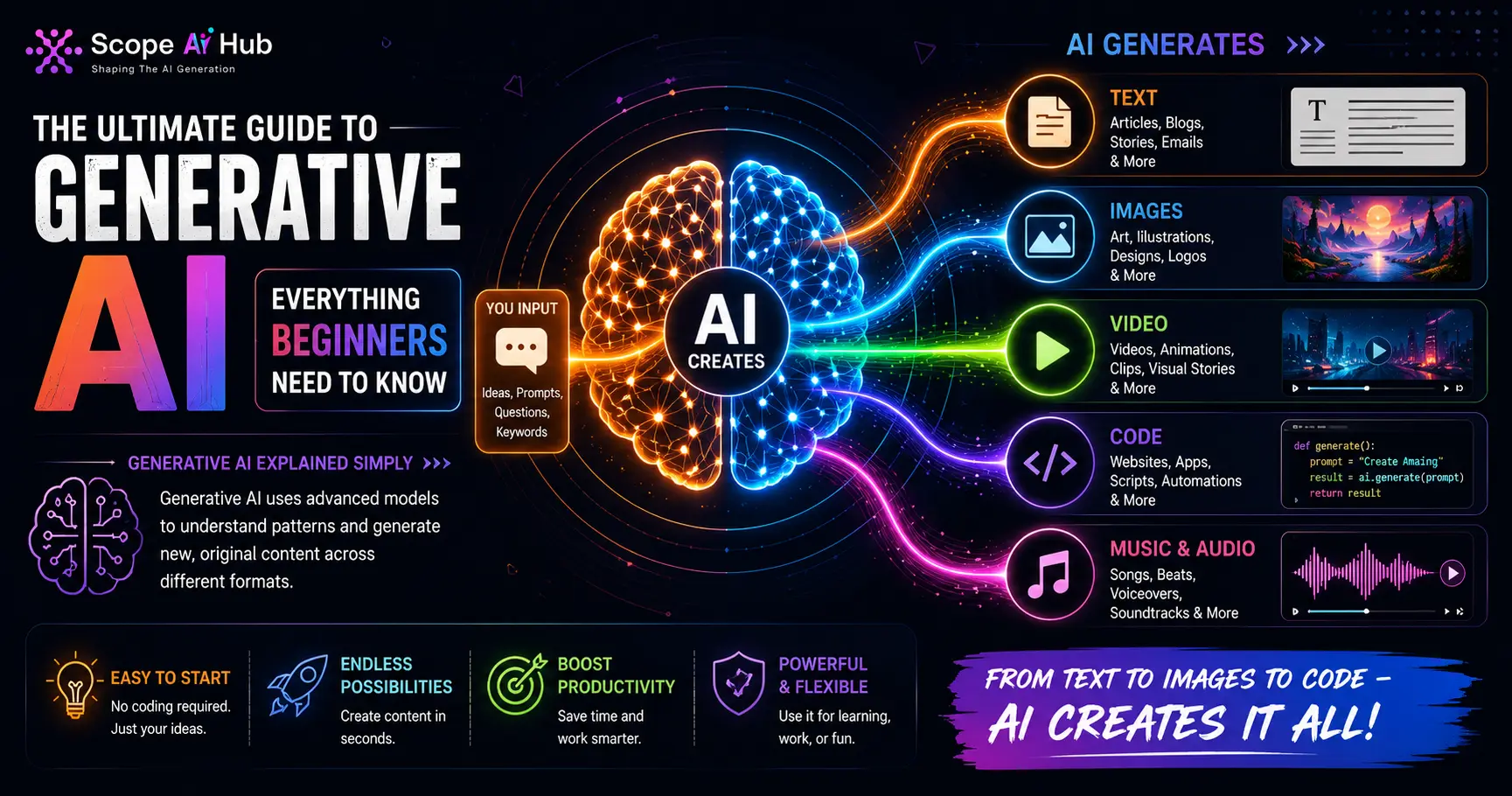
Generative AI is reshaping how we work, learn, and create. But terminology can overwhelm beginners. This guide breaks down everything you need to know.
What Is Generative AI?
Generative AI creates new content—text, images, code, videos, music—based on patterns learned from training data. Unlike traditional AI that recognizes patterns, generative AI produces original outputs.
How Does Generative AI Work?
Neural networks—mathematical models inspired by human brains—learn from billions of examples, then generate new content by predicting what should come next.
Explore the technical foundation in our Deep Learning Explained guide.
Types of Generative AI
Large Language Models (LLMs)
Generate human-like text: ChatGPT, Claude, Gemini.
Diffusion Models
Generate images: DALL-E, Midjourney, Stable Diffusion.
Video Models
Create videos: Runway, Make-A-Video.
Audio Models
Generate speech/music: Eleven Labs, AIVA.
Code Models
Write programming code: GitHub Copilot, Claude Code.
Learn practical application in our Python for AI guide.
The Generative AI Landscape 2026
Consumer Tools: ChatGPT, Claude, Gemini. Compare them in our ChatGPT vs Claude vs Gemini article. Design Tools: Midjourney, DALL-E, Adobe Firefly. Developer Tools: GitHub Copilot, Replit, LangChain. Enterprise: Custom models for companies. Mobile: Perplexity, Copilot, Claude mobile.
Why Is Generative AI Everywhere Now?
Three breakthroughs made it possible:
- Transformer Architecture (2017): Mathematical breakthrough enabling huge models.
- Scale: Companies trained models on billions of parameters.
- RLHF: Reinforcement Learning from Human Feedback aligned AI with preferences.
Real-World Applications
Business & Productivity
- Customer service chatbots
- Email and document writing
- Code generation
- Meeting summarization
Creative Industries
- Logo and graphic design
- Content creation
- Video production
- Music composition
Healthcare
- Medical report writing
- Research analysis
- Patient education
Education
- Personalized tutoring
- Curriculum creation
- Assignment grading
Capabilities & Limitations
What AI Is Good At
✅ Summarizing documents ✅ Writing first drafts ✅ Explaining concepts ✅ Brainstorming ✅ Code generation
What It Struggles With
❌ Real-time information ❌ Complex reasoning ❌ Factual accuracy ❌ Current events ❌ Professional authority
How to Use Generative AI Effectively
Rule 1: Collaborator, Not Replacement
AI generates drafts. You add creativity and judgment.
Rule 2: Iterate and Refine
First output rarely perfect. Ask follow-up questions as shown in our Prompt Engineering 101 guide.
Rule 3: Verify Information
Never trust AI blindly for critical facts.
Rule 4: Learn Your Tool Deeply
Each AI tool has quirks. Master one completely.
Rule 5: Think Ethically
Consider privacy, plagiarism, and bias. Our AI Ethics course covers responsible AI.
Career Opportunities
The field is hiring aggressively. See detailed salary ranges in our Generative AI Career Paths article:
- Prompt Engineers: ₹8-20 LPA
- AI Trainers: ₹6-15 LPA
- AI Product Managers: ₹15-30 LPA
- ML Engineers: ₹12-25 LPA
Common Misconceptions
Myth 1: "AI will replace all jobs" Reality: AI changes jobs, creates roles, increases productivity.
Myth 2: "AI understands like humans" Reality: AI recognizes patterns; understanding is limited.
Myth 3: "AI will be superintelligent soon" Reality: Current AI is narrow; general AI is theoretical.
Myth 4: "Using AI is cheating" Reality: Using tools effectively is a skill; always disclose.
Myth 5: "AI solves all problems" Reality: AI solves specific problems brilliantly, others not at all.
Your First Steps
- Sign up for ChatGPT (free at openai.com)
- Ask it to explain something you want to learn
- Try generating content in your field
- Experiment with different prompts (see Prompt Engineering guide)
- Join communities (Reddit, Discord)
The Takeaway
Generative AI is here to stay. The question isn't whether to use it, but how. Most successful professionals in 2026 master AI collaboration. Enroll in our Generative AI & Prompt Engineering course.
Your competitive advantage lies in prompt engineering skill, critical thinking, and knowing when to apply AI tools.
Scope AI Hub
Verified PublisherAI Education & Research Team
Scope AI Hub is Chennai's leading AI training institute, delivering industry-driven, hands-on AI education since 2019. Our expert team covers Generative AI, Machine Learning, NLP, Data Science, and MLOps.
Ready to Start Your AI Journey?
Join thousands of students who transformed their careers with hands-on AI training at Scope AI Hub.


