Python for AI: A Complete Beginner's Guide to Getting Started

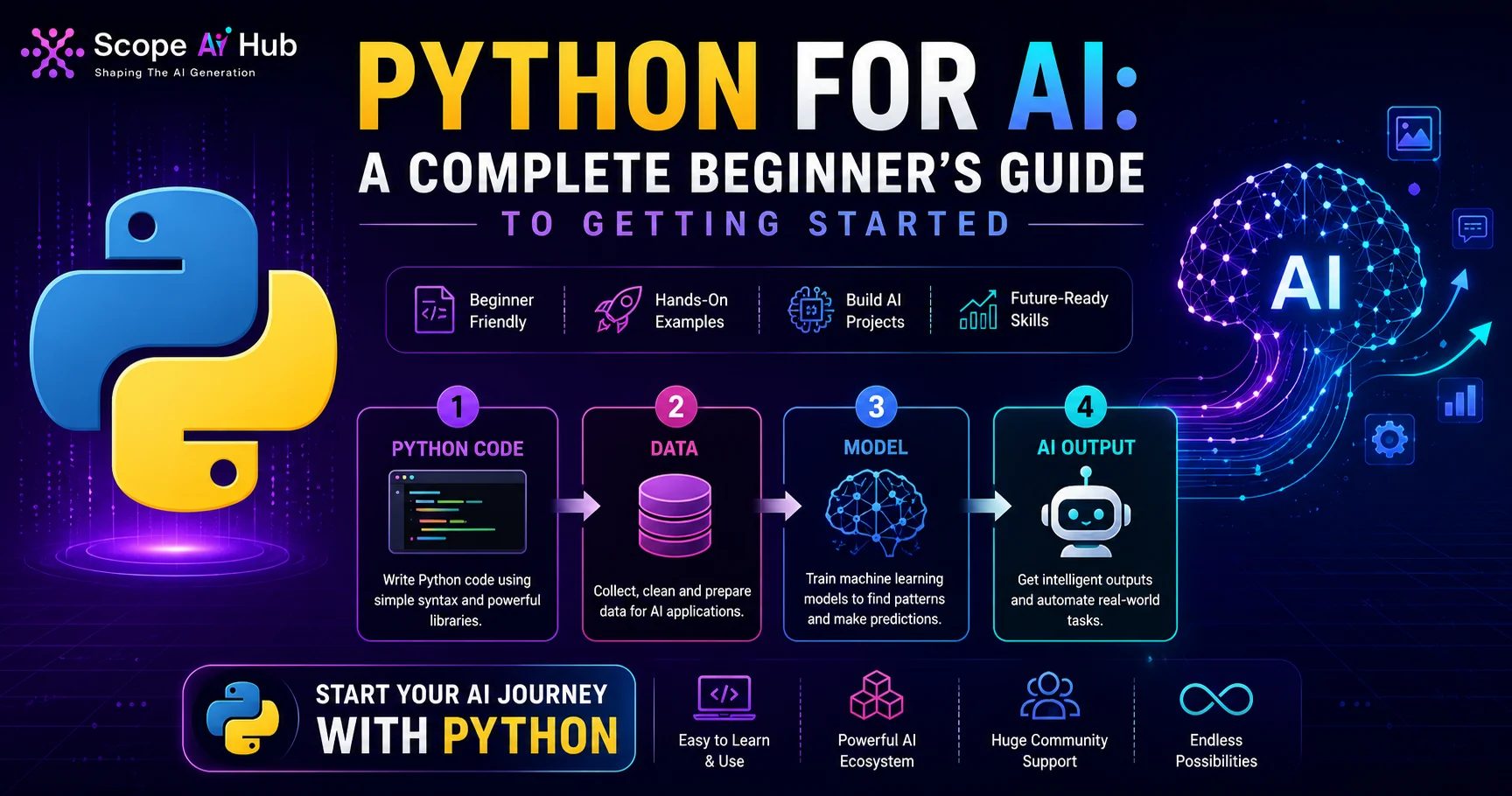
If you have decided to learn AI, you will hit the same question within the first week: which programming language should I learn? The answer, for almost everyone, is Python. This guide explains why, and gives you a realistic path from writing your first line of code to training a working model.
Why Python Won the AI Race
Python was not designed for artificial intelligence. It became the default for four practical reasons.
The syntax stays out of your way. Machine learning is conceptually hard on its own. You are learning about gradients, overfitting, and feature engineering. You do not also want to fight memory management or type declarations. Python lets you express an idea in roughly the number of lines it takes to describe it.
The libraries already exist. You will almost never implement a neural network from scratch in a job. You will use NumPy, Pandas, scikit-learn, and PyTorch, which are mature, well documented, and maintained by large teams. That ecosystem is the real reason Python dominates.
Research publishes in Python. When a new technique appears, the reference implementation is nearly always Python. If you read Python, you can read the field.
Employers expect it. Look at any AI or ML job listing in Chennai, Bangalore, or Hyderabad. Python appears in the required skills section more often than any other language, usually alongside SQL.
What You Actually Need to Learn First
Beginners routinely waste months here. They work through a general Python course covering decorators, metaclasses, and threading, then discover none of it comes up in their first ML project.
For AI work, you need a narrow slice of the language well, not the whole language shallowly:
- Variables and data types — integers, floats, strings, booleans
- Lists and dictionaries — the two structures you will use constantly
- Loops and conditionals —
for,while,if/else - Functions — defining them, arguments, return values
- Imports — how to bring a library into your file
- File handling and basic error handling — reading data, surviving bad rows
That is roughly two weeks of focused practice. Object-oriented programming matters later, when you start structuring larger projects, but you do not need it to train your first model.
Setting Up Without Frustration
Installation problems stop more beginners than any concept does. Save yourself the pain.
Install Anaconda, which bundles Python with most scientific libraries already configured. Alternatively, start in Google Colab, which runs in your browser with nothing to install and gives you free GPU access. For your first month, Colab is genuinely the path of least resistance.
Your first program:
print("Hello, AI World!")
Then confirm your tools are present:
import numpy as np
import pandas as pd
print(np.__version__, pd.__version__)
If that runs without an error, your environment is ready.
The Three Libraries That Matter Most
NumPy: the numerical foundation
Every other library is built on NumPy arrays. It handles vectors, matrices, and fast mathematical operations.
import numpy as np

scores = np.array([72, 85, 90, 68, 95])
print(scores.mean())      # 82.0
print(scores.max())       # 95
print(scores * 1.1)       # scale every value at once
That last line is the important one. NumPy applies the operation to every element without a loop. This is called vectorisation, and it is why NumPy is dramatically faster than plain Python for numerical work.
Pandas: the data workhorse
Real data arrives messy, in CSV files and database exports. Pandas is how you clean and shape it. In practice, you will spend far more time here than on modelling.
import pandas as pd

df = pd.read_csv('students.csv')
print(df.head())              # first five rows
print(df.describe())          # summary statistics
print(df.isnull().sum())      # count missing values per column

df = df.dropna()                          # drop incomplete rows
high_scorers = df[df['score'] > 80]       # filter
average_by_city = df.groupby('city')['score'].mean()
If you master one library early, make it Pandas. It is the difference between being stuck and being productive.
Scikit-learn: your first models
Scikit-learn gives you classical machine learning with a consistent interface. Every model uses the same three methods: fit, predict, score.
from sklearn.model_selection import train_test_split
from sklearn.linear_model import LogisticRegression

X_train, X_test, y_train, y_test = train_test_split(
    X, y, test_size=0.2, random_state=42
)

model = LogisticRegression()
model.fit(X_train, y_train)
print(model.score(X_test, y_test))
Because the interface is uniform, swapping LogisticRegression for RandomForestClassifier is a one-line change. That consistency is what makes scikit-learn such a good teaching library.
A Realistic Eight-Week Plan
Weeks 1 to 2 — Python fundamentals. Variables, lists, dictionaries, loops, functions. Write small programs daily. Do not skip to machine learning yet.
Weeks 3 to 4 — NumPy and Pandas. Load a real CSV from Kaggle. Clean it. Answer questions about it. Aim for comfort, not mastery.
Weeks 5 to 6 — Scikit-learn. Train your first classifier. Learn what a train/test split is and why it exists. Understand accuracy, precision, and recall.
Weeks 7 to 8 — One complete project. Take a dataset end to end, from raw file to working model, and write up what you found.
Deep learning frameworks come after this, not during. PyTorch will make far more sense once you understand what a model is doing.
Mistakes That Slow Beginners Down
Tutorial hell. Watching courses feels productive and teaches almost nothing on its own. Write code. Break it. Fix it.
Skipping the data work. Everyone wants to build neural networks. Most real jobs are cleaning and understanding data. The people who are good at Pandas are the ones who ship.
Starting with deep learning. Neural networks assume you already understand training, evaluation, and overfitting. Learn those on simpler models where results are interpretable.
Not using version control. Learn basic Git early. Employers check GitHub profiles, and a public repository of small projects is a stronger signal than a certificate.
Where This Leads
Python is the entry point, not the destination. Once you are comfortable, the path branches toward machine learning engineering, data analysis, NLP, or computer vision. Our Python for AI and Machine Learning course covers this ground with hands-on projects and small batches, and if you are weighing career directions, our guide on how to start a career in AI with no experience maps out the options.
The honest summary: Python is learnable. The libraries are the real skill, data handling is the real work, and projects are what get you hired.
Frequently Asked Questions
Q: How long does it take to learn Python for AI?
A: Around two weeks for the fundamentals and eight to ten weeks to reach the point where you can build a project independently, assuming consistent daily practice. Job-ready competence typically takes six months including projects.
Q: Do I need to be good at mathematics?
A: For entry-level work, comfort with basic statistics, percentages, and averages is enough. Linear algebra and calculus become important if you move into research or designing model architectures.
Q: Should I learn Python 2 or Python 3?
A: Python 3. Python 2 reached end of life in 2020 and is no longer supported.
Q: Is Python enough on its own to get an AI job?
A: Python plus SQL plus one or two demonstrable projects is the realistic minimum. Python alone, with no portfolio, rarely clears the first screening.
Scope AI Hub
Verified PublisherAI Education & Research Team
Scope AI Hub is Chennai's leading AI training institute, delivering industry-driven, hands-on AI education since 2019. Our expert team covers Generative AI, Machine Learning, NLP, Data Science, and MLOps.
Ready to Start Your AI Journey?
Join thousands of students who transformed their careers with hands-on AI training at Scope AI Hub.


