Supervised vs Unsupervised Learning: Which Approach Does Your Problem Need?

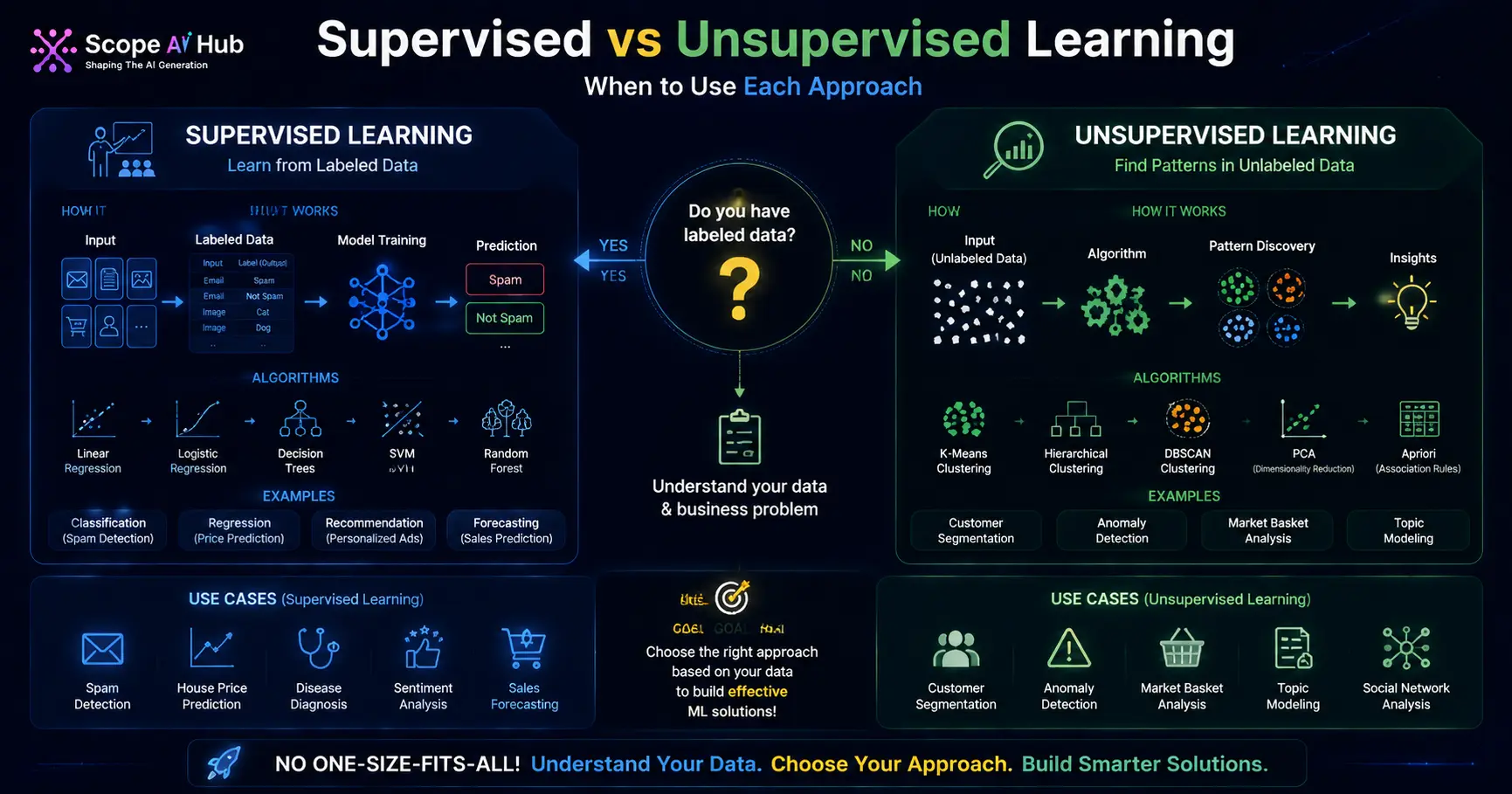
One of the first decisions in any ML project is whether you are dealing with a supervised or unsupervised learning problem. This is not a stylistic preference — it is determined by what data you have and what you are trying to learn from it. Getting this choice right sets up the rest of the project correctly. Getting it wrong wastes weeks of work.
The distinction is simpler than it is sometimes made to sound: supervised learning requires labeled examples, unsupervised learning does not. Everything else follows from that.
Supervised Learning: Learning from Labels
In supervised learning, every training example consists of an input and a corresponding label — the correct answer. The model learns a mapping from inputs to outputs by seeing many input-label pairs.
The supervision is the label. A teacher (the labeled dataset) tells the model: "For this input, the correct output is X." The model adjusts its parameters to match those labels as closely as possible, then generalizes that learned mapping to new inputs it has not seen before.
What Supervised Learning Problems Look Like
Classification: The output is a category. Binary classification (two categories: fraud/not-fraud, churn/not-churn, defect/acceptable), multi-class (which of ten product categories does this listing belong to?), or multi-label (which of these topics does this article discuss? — it may have multiple correct labels).
To train a classifier, you need labeled examples: "This transaction is fraudulent. This one is not. This customer churned. This one did not." The quality and quantity of these labels directly determines the ceiling on your model's accuracy.
Regression: The output is a continuous number. Predict the sale price of a property given its features. Forecast next month's electricity demand. Estimate a customer's lifetime value. Predict how many units of a product will sell next week.
Regression requires labeled examples where the label is a number rather than a category: "This apartment sold for ₹85 lakhs. This one sold for ₹1.2 crore." The model learns the relationship between property features and price from these examples.
Real Indian Business Applications
Credit scoring (banking and fintech): Train a model on historical loan applications with known outcomes (repaid or defaulted). The model learns which applicant features (income, employment history, credit behavior, demographic data) are associated with repayment versus default. For new applications, it predicts default probability.
Demand forecasting (retail and e-commerce): Train on historical sales data labeled with quantities sold. Features include time (day of week, month, year, festivals, paydays), product characteristics, pricing, promotional activity, and regional factors. The model predicts future demand.
Medical diagnosis (healthcare): Train on patient records labeled with diagnoses or outcomes. A model trained on thousands of chest X-rays labeled by radiologists learns to predict diagnostic categories for new X-rays.
Document classification: Train on documents labeled with categories (invoice, purchase order, contract, ID document). The model classifies incoming scanned documents automatically, routing them to the appropriate workflow.
The Label Requirement is a Real Constraint
Supervised learning sounds powerful — and it is — but the label requirement is not trivial to satisfy. You need:
- Enough labeled examples (often thousands to tens of thousands minimum for reliable models)
- Labels that are accurate (label noise degrades model quality significantly)
- Labels that represent the full distribution of inputs the model will encounter in production (biased training data produces biased models)
Labeling is often expensive. Medical image labeling requires expert radiologists. Legal document classification requires lawyers. The annotation cost is a real factor in whether supervised learning is feasible for a given problem.
Unsupervised Learning: Finding Structure Without Labels
In unsupervised learning, you have inputs but no labels. The goal is to discover patterns, structure, or representations in the data itself — not to predict a predefined output.
This fundamentally changes the problem setup. There is no "correct answer" defined in advance. You are exploring the data to find whatever structure is present.
Clustering: Grouping Similar Things Together
Clustering algorithms partition data into groups (clusters) such that items within a group are similar to each other and different from items in other groups. The number and nature of groups is discovered from the data, not specified in advance.
K-Means is the simplest and most widely used clustering algorithm. You specify K (the number of clusters) and the algorithm assigns each data point to the nearest cluster center, then updates the centers, repeating until stable.
from sklearn.cluster import KMeans
import pandas as pd

# Customer behavioral features — no labels
df = pd.DataFrame({
    'monthly_spend': [500, 1200, 3500, 4200, 800, 2100, 150, 5500],
    'purchase_frequency': [2, 5, 12, 15, 3, 8, 1, 20],
    'avg_order_value': [250, 240, 292, 280, 267, 263, 150, 275]
})

# Discover 3 customer segments
kmeans = KMeans(n_clusters=3, random_state=42, n_init=10)
df['segment'] = kmeans.fit_predict(df)

# Analyze what each segment looks like
print(df.groupby('segment').mean())
The output segments might reveal: a high-frequency, high-value customer group (loyalty program candidates), a medium-frequency mainstream group (the core market), and a low-frequency, low-value group (casual buyers). The business can then apply different strategies to each segment.
DBSCAN is an alternative that automatically determines the number of clusters and handles non-spherical shapes. It identifies clusters as dense regions separated by sparse regions, and labels outliers as noise points — useful when you expect anomalies in your data.
Hierarchical clustering builds a tree (dendrogram) showing nested cluster relationships. Useful when you want to understand multiple levels of similarity — how fine or coarse your segmentation should be.
Dimensionality Reduction: Finding Compact Representations
Real-world datasets often have hundreds or thousands of features. High dimensionality creates problems: models are harder to train, patterns are harder to visualize, and unimportant features add noise. Dimensionality reduction techniques find lower-dimensional representations that preserve the most important structure.
PCA (Principal Component Analysis) finds the directions of maximum variance in the data and projects the data onto a lower-dimensional subspace defined by those directions. It is linear, fast, and interpretable.
from sklearn.decomposition import PCA
from sklearn.preprocessing import StandardScaler

# Standardize first — PCA is sensitive to scale
scaler = StandardScaler()
X_scaled = scaler.fit_transform(X)

# Reduce to 2 dimensions for visualization
pca = PCA(n_components=2)
X_2d = pca.fit_transform(X_scaled)

print(f"Variance explained: {pca.explained_variance_ratio_.sum():.1%}")
# If this says 85%, the 2D representation captures 85% of the original variation
t-SNE (t-Distributed Stochastic Neighbor Embedding) is non-linear and specializes in visualization — it creates 2D or 3D representations that preserve local neighborhoods, making clusters visually apparent. Widely used for visualizing high-dimensional embeddings (like word vectors or image features).
Autoencoders are neural network approaches to dimensionality reduction. An encoder compresses the input to a lower-dimensional latent space; a decoder attempts to reconstruct the original input from the compressed representation. The compressed representation is the useful output.
Anomaly Detection: Finding the Unusual
Anomaly detection identifies data points that deviate significantly from the normal pattern. It is a natural fit for unsupervised learning because anomalies, by definition, are rare — you rarely have enough labeled examples of rare events to train a supervised classifier effectively.
Isolation Forest isolates anomalies by randomly partitioning the feature space. Anomalies are data points that are isolated easily with few partitions — they sit in sparse regions far from the normal data distribution.
Autoencoders for anomaly detection: Train an autoencoder on normal data only. The autoencoder learns to reconstruct normal patterns well. Anomalous inputs are reconstructed poorly (high reconstruction error) because the model has only seen normal patterns. High reconstruction error flags a potential anomaly.
Applications: credit card fraud detection, manufacturing quality control, IT security (detecting unusual network traffic patterns), predictive maintenance (detecting sensor readings that deviate from normal machine operation).
Semi-Supervised and Self-Supervised Learning
The supervised/unsupervised distinction is actually a spectrum. Two important points on that spectrum:
Semi-supervised learning uses a small amount of labeled data alongside a large amount of unlabeled data. This is practically important because labeled data is expensive and unlabeled data is often abundant. The unlabeled data helps the model learn better representations even though it does not directly provide supervision.
Self-supervised learning creates supervision from the data itself without human labels. BERT is trained by masking random words in text and training the model to predict the masked words — the text itself provides the supervision. GPT is trained by predicting the next word in a sequence. This is how large language models learn from internet-scale text without human-labeled examples.
Self-supervised learning is arguably the most important recent advance in AI — it is what made large-scale pretraining practical without requiring enormous human annotation efforts.
Choosing Between Supervised and Unsupervised
The decision tree is fairly straightforward:
If you have labeled examples and want to predict a defined output → Supervised learning. Classification or regression depending on whether the output is a category or a number.
If you do not have labels, or your goal is exploration/discovery rather than prediction → Unsupervised learning. Clustering for segmentation, PCA/t-SNE for visualization, autoencoders for representation learning, isolation forest for anomaly detection.
If you have some labels but not enough → Consider semi-supervised approaches or transfer learning (pretrain on unlabeled data, fine-tune on labeled data).
If you have labels but they are very expensive to acquire → Consider active learning, which identifies the most informative examples to label next, reducing the total annotation cost.
How Both Approaches Appear in Real Projects
In practice, supervised and unsupervised learning are often used together rather than in isolation.
A common pattern: use clustering to segment customers into groups, then train a separate supervised classifier for each segment (because different segments may have different churn patterns that a single model would average away). Or use PCA to reduce feature dimensionality before training a supervised classifier — this handles multicollinearity and speeds up training.
Anomaly detection (unsupervised) is often the first pass in a fraud detection pipeline, flagging suspicious transactions for review; supervised classification is then applied to the flagged set where labels exist.
Learning Path
Our Machine Learning and Deep Learning course covers both supervised learning (regression, classification, gradient boosting, neural networks) and unsupervised learning (clustering, dimensionality reduction, anomaly detection) with hands-on Python implementation throughout. The Python for AI and Machine Learning course builds the prerequisite programming and data manipulation skills.
Frequently Asked Questions
Q: Is one approach better than the other? A: Neither is better — they solve different problems. Supervised learning is more powerful when labels are available because it directly optimizes for the output you care about. Unsupervised learning is necessary when labels are absent or the problem is exploratory.
Q: How do you evaluate an unsupervised model if there are no correct answers? A: With difficulty, and this is a genuine challenge. For clustering: silhouette score (how well-separated clusters are), within-cluster inertia, and domain expert validation (do these segments make business sense?). For anomaly detection: if you have any ground truth labels for a subset of anomalies, use those. For dimensionality reduction: variance explained (PCA), reconstruction error (autoencoders).
Q: Can I use deep learning for unsupervised problems? A: Yes. Autoencoders are deep learning models for unsupervised learning. Generative models (GANs, VAEs, diffusion models) are deep learning approaches to learning data distributions without labels. Self-supervised pretraining (BERT, GPT) is perhaps the most impactful application of deep learning without explicit human labels.
Q: What is the typical ratio of supervised to unsupervised work in Indian ML jobs? A: Most production ML jobs in India lean heavily toward supervised learning — classification and regression on structured business data, with gradient boosting or neural networks. Unsupervised learning appears most in data exploration, customer segmentation (common in e-commerce and fintech), and anomaly detection (fraud, quality control). Knowing both is expected; being primarily hired to do unsupervised learning alone is less common.
Ready to Build ML Systems From Scratch?
Our hands-on Chennai batches cover the full ML toolkit — supervised, unsupervised, and everything in between — with real projects.
📞 Call/WhatsApp: +91 70102 30379 📧 Email: info@scopeaihub.com 📍 Visit Us: 10, Tilak St, T. Nagar, Chennai – 600017 🌐 Website: www.scopeaihub.com
Scope AI Hub
Verified PublisherAI Education & Research Team
Scope AI Hub is Chennai's leading AI training institute, delivering industry-driven, hands-on AI education since 2019. Our expert team covers Generative AI, Machine Learning, NLP, Data Science, and MLOps.
Ready to Start Your AI Journey?
Join thousands of students who transformed their careers with hands-on AI training at Scope AI Hub.


