Predictive Analytics Using Machine Learning: Forecasting Business Outcomes

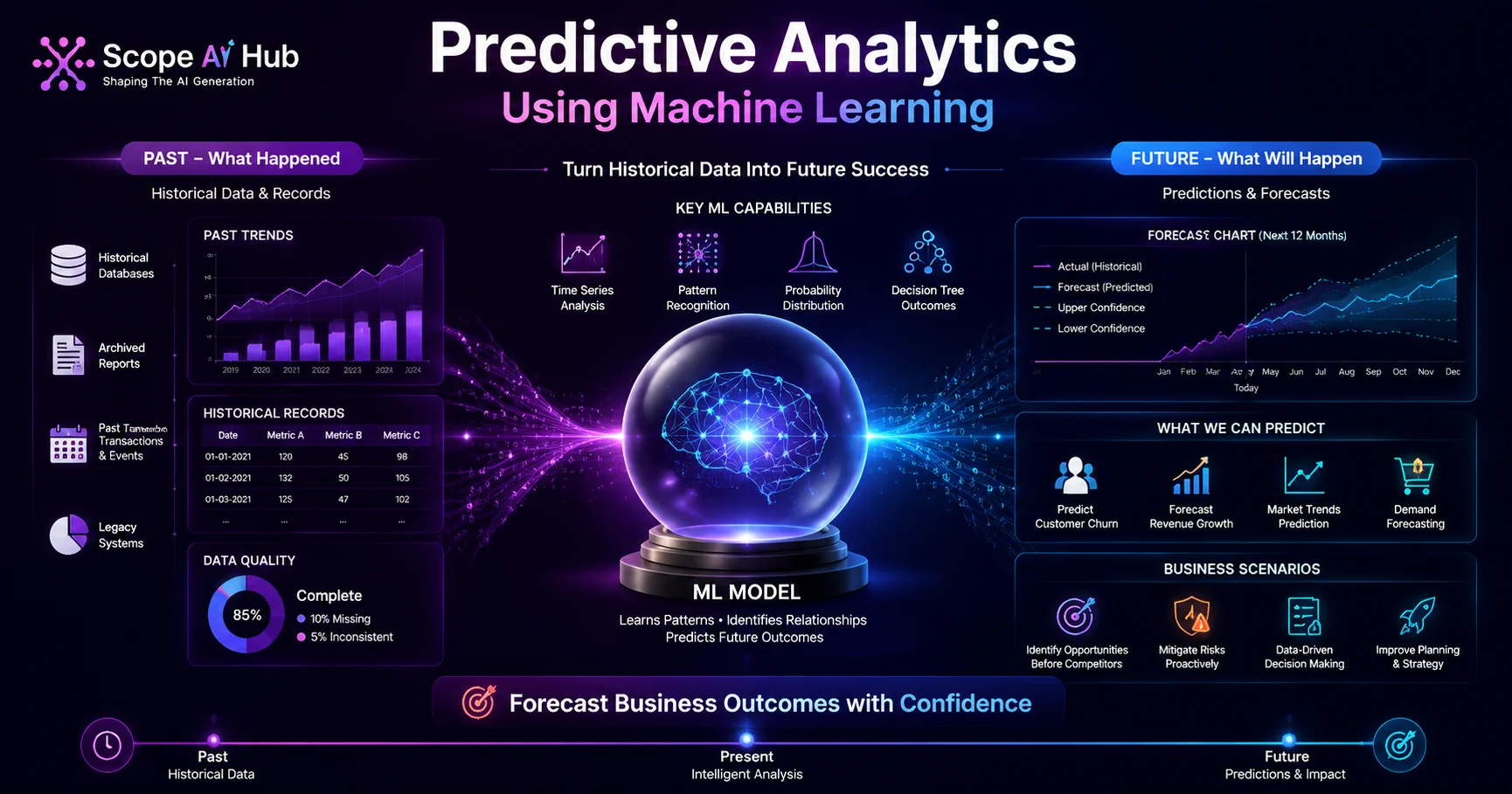
Predictive analytics uses historical data to forecast future outcomes. It powers demand forecasting, risk prediction, and customer behavior modeling across industries.
Core Concepts
Regression predicts continuous values (price, temperature, sales). Classification predicts categories (churn/retain, buy/not buy). Time Series forecasts sequential data (stock prices, weather).
Common Applications
- Sales forecasting: Predict revenue, optimize inventory
- Customer churn: Identify at-risk customers, reduce churn
- Risk prediction: Credit scoring, fraud detection, insurance pricing
- Demand forecasting: Anticipate demand, reduce stockouts
- Asset maintenance: Predict equipment failures before they occur
Modeling Process
- Data collection: Gather historical data
- Feature engineering: Create predictive variables
- Model selection: Choose appropriate algorithm
- Training: Fit model on historical data
- Evaluation: Test on unseen data
- Deployment: Put model in production
- Monitoring: Track performance over time
Algorithms
Linear Regression: Simple baseline for continuous predictions. Random Forest: Powerful ensemble for complex relationships. ARIMA: Time series forecasting with temporal patterns. XGBoost: State-of-the-art for most tabular data. Neural Networks: Deep learning for complex patterns.
Accuracy Metrics
- RMSE: Root mean squared error
- MAE: Mean absolute error
- R²: Proportion of variance explained
- MAPE: Mean absolute percentage error
Real-World Examples
Retail: Predict sales per store, optimize staffing. Result: 15% improvement in labor efficiency. Finance: Credit risk scoring predicts loan defaults. Result: Reduces losses by $50M+ annually. Utilities: Forecast electricity demand. Result: Reduces waste, optimizes generation.
Challenges
- Data quality: Garbage in, garbage out
- Changing patterns: Past patterns may not predict future
- Overfitting: Model memorizes training data
- Explainability: Why did model make prediction?
Best Practices
- Start with simple models
- Establish baseline performance
- Use proper train/test splits
- Monitor for data drift
- Retrain regularly
- Document assumptions
Business Impact
Organizations with predictive analytics capabilities grow revenue 15-25% faster and reduce costs by 20-30%.
Key Takeaways
- Predictive models forecast outcomes from historical data
- Regression predicts continuous values, classification predicts categories
- Feature engineering is critical for model performance
- Validation on unseen data prevents overfitting
- Production systems need continuous monitoring
Explore machine learning fundamentals in our Machine Learning & Deep Learning course.
Scope AI Hub
Verified PublisherAI Education & Research Team
Scope AI Hub is Chennai's leading AI training institute, delivering industry-driven, hands-on AI education since 2019. Our expert team covers Generative AI, Machine Learning, NLP, Data Science, and MLOps.
Ready to Start Your AI Journey?
Join thousands of students who transformed their careers with hands-on AI training at Scope AI Hub.


