Building Production-Ready Machine Learning Models: Beyond Jupyter Notebooks

2 mins
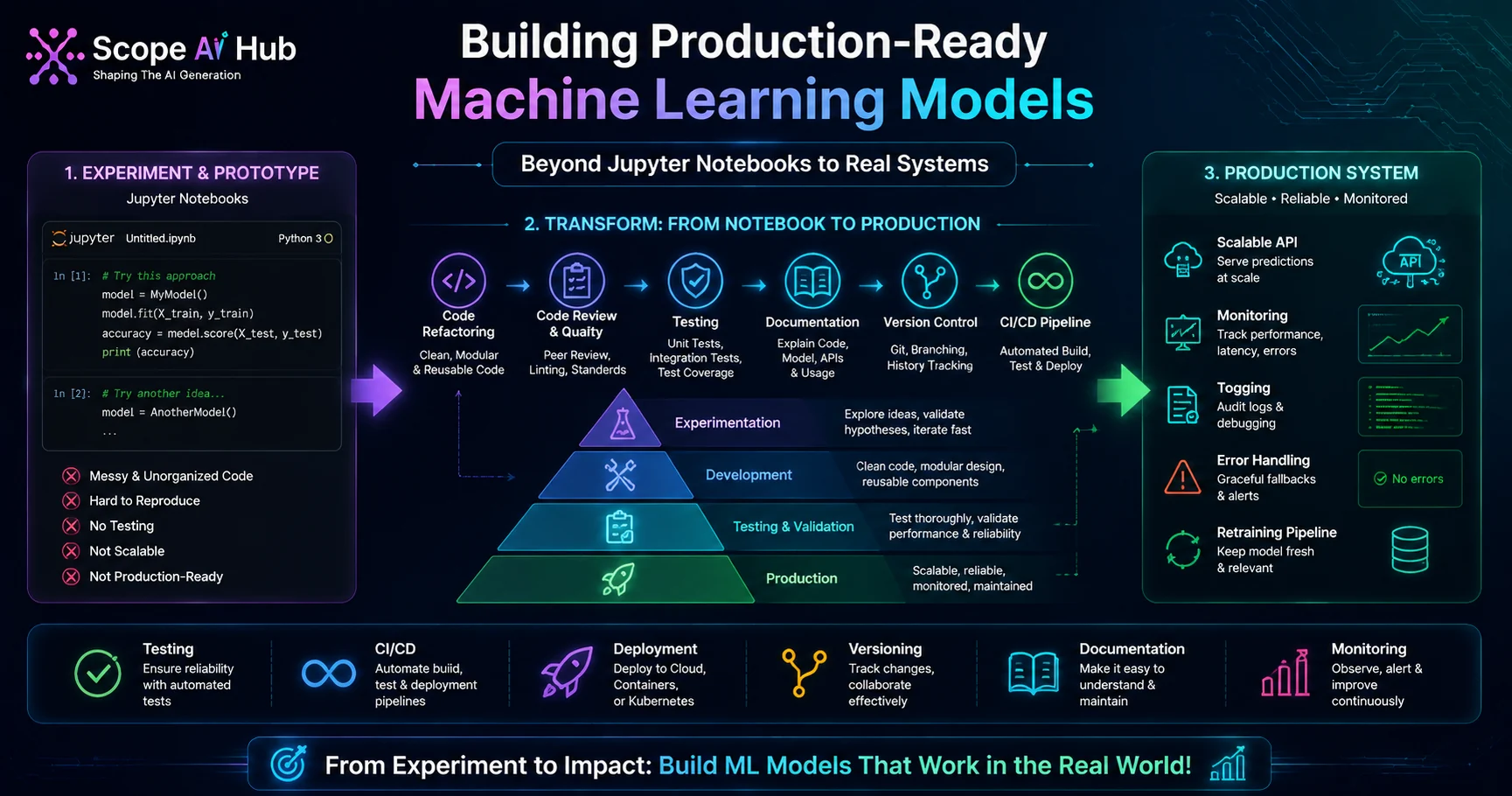
Building ML models in Jupyter notebooks is different from deploying production systems. Production ML requires reliability, scalability, and monitoring.
From Notebook to Production
Notebook: Experimental, single user, no performance requirements Production: Reliable, multi-user, strict latency/accuracy SLAs
Production ML Architecture
Data Pipeline → Model Training → Model Registry → Model Serving → Monitoring
Key Components
1. Model Management
- Version control (track model changes)
- Metadata tracking (hyperparameters, metrics)
- Model registry (centralized models)
- Tools: MLflow, Weights & Biases
2. Model Serving
- REST APIs (FastAPI, Flask)
- Batch processing (daily predictions)
- Real-time streaming (immediate predictions)
- Tools: TensorFlow Serving, Seldon Core
3. Infrastructure
- Containerization (Docker)
- Orchestration (Kubernetes)
- Auto-scaling (handle traffic spikes)
- Cloud platforms (AWS SageMaker, Google Cloud AI)
4. Monitoring & Maintenance
- Prediction latency tracking
- Model accuracy monitoring
- Data drift detection (input distribution changes)
- Retraining triggers
Data Pipeline
Production systems need:
- ETL processes for data collection
- Data validation (quality checks)
- Feature engineering at scale
- Data versioning
Model Performance Monitoring
Track:
- Latency: Response time for predictions
- Throughput: Predictions per second
- Accuracy: Performance on production data
- Distribution shift: Has data changed?
Common Pitfalls
- No version control
- Manual model deployment
- No monitoring of model accuracy
- Hardcoded preprocessing
- No fallback strategy
Best Practices
- Containerize models (Docker)
- Automate training/deployment (CI/CD)
- Monitor constantly
- Version everything (data, code, models)
- Implement A/B testing
- Plan for rollback
- Document thoroughly
Real-World Example
Recommendation system deployment:
- Train: Daily model retraining
- Serve: REST API with <100ms latency
- Monitor: Track CTR (click-through rate)
- Fallback: Show popular items if model errors
- Result: 95% uptime, 20% improved recommendations
Tools & Stack
- ML Framework: TensorFlow, PyTorch
- Model Registry: MLflow, Hugging Face Hub
- Serving: FastAPI, Flask
- Monitoring: Prometheus, Datadog
- Orchestration: Airflow, Kubeflow
Key Takeaways
- Production differs fundamentally from notebooks
- Reliability and monitoring are critical
- Automation scales better than manual processes
- Version everything (data, models, code)
- Implement monitoring from day one
- Plan for model degradation and fallbacks
Learn more in our Machine Learning & Deep Learning course.
Scope AI Hub
Verified PublisherAI Education & Research Team
Scope AI Hub is Chennai's leading AI training institute, delivering industry-driven, hands-on AI education since 2019. Our expert team covers Generative AI, Machine Learning, NLP, Data Science, and MLOps.
Artificial IntelligenceMachine LearningGenerative AIData Science+2 more
Tags:Production MlModel DeploymentMlopsModel Serving
Ready to Start Your AI Journey?
Join thousands of students who transformed their careers with hands-on AI training at Scope AI Hub.


