BERT vs GPT: How Transformer Models Work in NLP

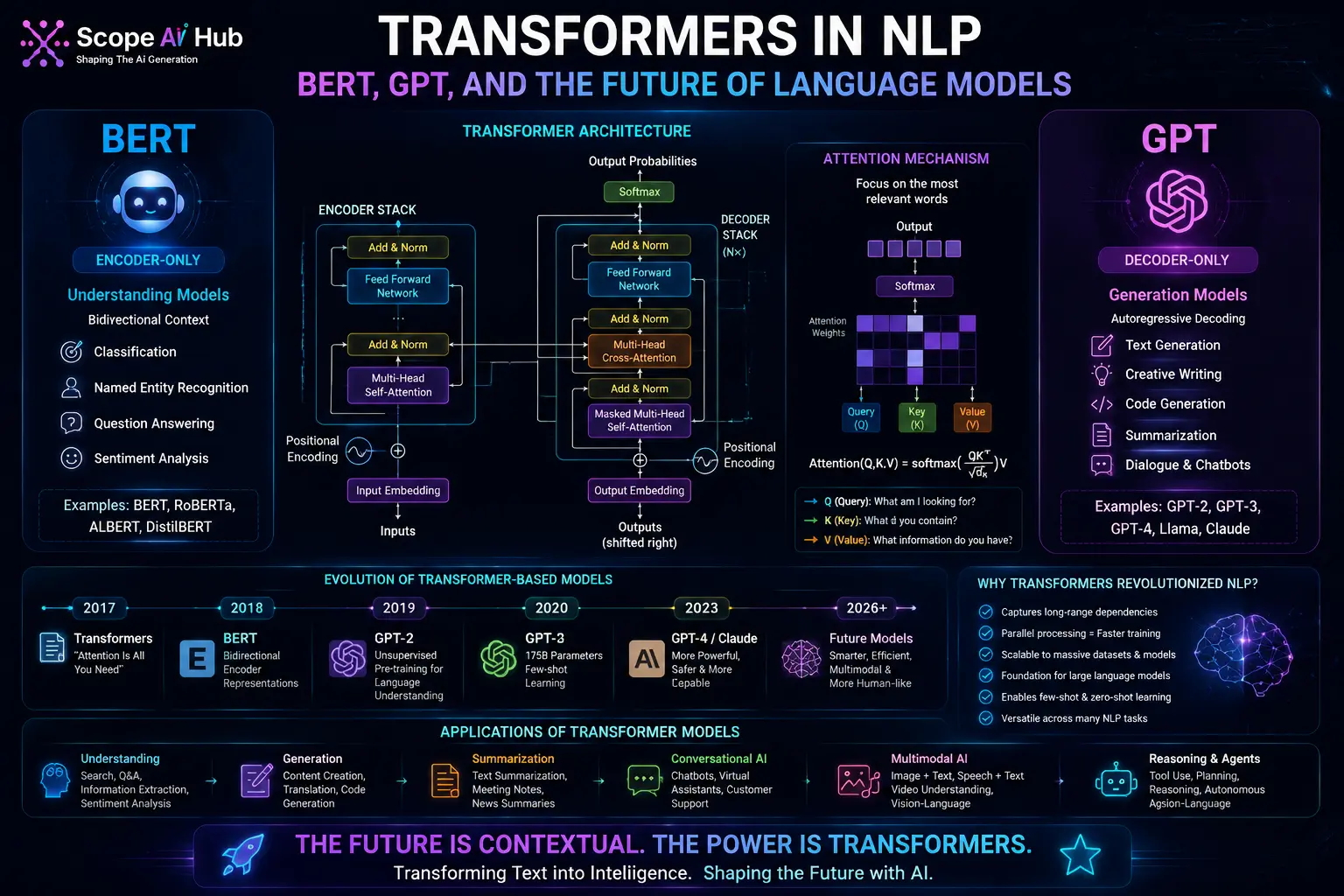
BERT and GPT are both transformer models. BERT reads a whole sentence at once to understand it; GPT reads left to right to continue it. That single design choice decides what each is good at: BERT for classifying, searching and extracting, GPT for writing, chatting and generating code.
This guide explains what BERT is in NLP, how it differs from GPT, how the attention mechanism underneath both works, and how to pick one for a real project.
What Is a Transformer?
A transformer is a neural network architecture, introduced in the 2017 paper "Attention Is All You Need", that processes a whole sequence of tokens in parallel using self-attention. Earlier models (RNNs and LSTMs) read one word at a time, which was slow to train and struggled to connect words far apart in a sentence.
Self-attention lets every token look at every other token and decide how much each one matters. In "The bank approved the loan because it was profitable", attention is what lets the model link "it" to "bank" rather than "loan".
The original transformer had two halves:
- An encoder, which turns input text into rich contextual representations.
- A decoder, which generates output one token at a time.
BERT keeps only the encoder. GPT keeps only the decoder. Almost everything about how they behave follows from that.
What Is BERT in NLP?
BERT (Bidirectional Encoder Representations from Transformers) is an encoder-only transformer released by Google in 2018. "Bidirectional" means that when BERT builds a representation of a word, it uses the words on both sides of it at the same time.
How BERT is trained
BERT is pre-trained on large text corpora with two tasks:
- Masked language modelling (MLM) – about 15% of tokens are hidden, and the model predicts them from the surrounding context. "The [MASK] approved the loan" forces it to use both the left and right context.
- Next sentence prediction (NSP) – the model predicts whether sentence B actually follows sentence A. (Later variants such as RoBERTa dropped this task and trained longer instead.)
After pre-training, BERT is fine-tuned: you add a small task-specific layer on top and train on a few thousand labelled examples of your own task.
What BERT is used for
- Text classification – spam detection, sentiment, ticket routing, intent detection.
- Named entity recognition – pulling names, amounts, dates and product codes out of documents.
- Extractive question answering – finding the span in a document that answers a question.
- Semantic search and similarity – sentence-embedding models built on BERT (such as Sentence-BERT) power most "search by meaning" and RAG retrieval systems.
For these tasks a fine-tuned BERT-sized model is often more accurate, far cheaper and much faster than calling a large generative model.
What Is GPT?
GPT (Generative Pre-trained Transformer) is a decoder-only transformer. It is trained on one objective: predict the next token given all previous tokens. Because it only ever looks left, it is naturally a generator – feed it a prompt and it keeps writing.
Scaled up to billions of parameters and further trained on instructions and human feedback, this same architecture gives chat assistants such as ChatGPT. GPT-style models are used for:
- Chatbots and assistants
- Summarisation and drafting
- Code generation
- Translation and rewriting
- Reasoning over documents supplied in the prompt
BERT vs GPT: Side-by-Side Comparison
| Aspect | BERT | GPT |
|---|---|---|
| Architecture | Encoder only | Decoder only |
| Reads context | Both directions at once | Left to right |
| Pre-training task | Masked word prediction | Next word prediction |
| Best at | Understanding: classify, extract, search | Generating: write, chat, code |
| Typical size | 110M–340M parameters (base/large) | Billions of parameters |
| How you adapt it | Fine-tune on labelled data | Prompting, or fine-tuning |
| Cost to run | Low – runs on a CPU or small GPU | High – usually an API or large GPUs |
| Example uses | Search ranking, NER, sentiment, RAG retrieval | Chatbots, content, coding assistants |
Rule of thumb: if the output is a label, a span or a score, start with a BERT-family model. If the output is new text, use a GPT-style model.
How the Attention Mechanism Works
Both models are built from stacked attention layers. For each token, the model creates three vectors:
- Query – what this token is looking for.
- Key – what this token offers to others.
- Value – the information it passes on.
Attention scores are the dot products of one token's query with every token's key, scaled and passed through a softmax to become weights. Each token's new representation is the weighted sum of all the value vectors.
Multi-head attention runs several of these in parallel, so one head can track grammar while another tracks which noun a pronoun refers to. The only real difference between BERT and GPT here is a mask: GPT's attention is blocked from looking at future tokens; BERT's is not.
Other Transformer Models Worth Knowing
- RoBERTa – BERT trained longer on more data without NSP; usually more accurate.
- DistilBERT – about 40% smaller and 60% faster than BERT while keeping most of its accuracy; good for production.
- DeBERTa – improved attention; strong on classification benchmarks.
- T5 and BART – encoder–decoder models for translation and summarisation.
- IndicBERT and MuRIL – trained on Indian languages; the starting point for Hindi, Tamil and other Indian-language NLP.
Is BERT Still Relevant in 2026?
Yes. Large generative models get the attention, but a lot of production NLP still runs on BERT-family encoders because they are cheap, fast and accurate for narrow tasks. Most retrieval-augmented generation (RAG) systems use an encoder model to find the right documents and a GPT-style model to write the answer – so modern systems usually combine both.
Getting Started with BERT in Python
The Hugging Face transformers library lets you run a pre-trained model in a few lines:
from transformers import pipeline

classifier = pipeline("sentiment-analysis")  # downloads a fine-tuned DistilBERT
print(classifier("The course projects were genuinely useful."))
From there, the usual path is: pick a base model, fine-tune it on your labelled data with the Trainer API, evaluate on a held-out set, then deploy. If you are new to Python for AI, start with Python for AI Beginners and the essential Python libraries for machine learning.
Related reading: how to build a chatbot with NLP, multilingual NLP for Indian languages, sentiment analysis and what NLP engineers build in 2026.
Frequently Asked Questions
Q: What is BERT in NLP?
A: BERT is an encoder-only transformer model from Google that reads text in both directions at once. It is pre-trained by predicting masked words and then fine-tuned for tasks such as classification, named entity recognition, question answering and semantic search.
Q: What is the difference between BERT and GPT?
A: BERT is an encoder that reads the whole sentence at once and is best at understanding tasks. GPT is a decoder that reads left to right and is best at generating text. BERT is trained to fill in masked words; GPT is trained to predict the next word.
Q: Is BERT better than GPT?
A: Neither is better overall. BERT-family models are usually cheaper, faster and more accurate for classification, extraction and search. GPT-style models are the right choice when the output is new text.
Q: Is ChatGPT based on BERT?
A: No. ChatGPT is built on GPT, a decoder-only transformer. BERT and GPT share the transformer building blocks but use different halves of the original architecture.
Q: Do I need to know deep learning to use BERT?
A: Not to use it – the Hugging Face library lets you run pre-trained models with a few lines of Python. To fine-tune and deploy it well, you need Python, basic machine learning and an understanding of evaluation.
Key Takeaways
- Transformers use self-attention to process whole sequences in parallel.
- BERT is an encoder: bidirectional, trained on masked words, best for understanding.
- GPT is a decoder: left to right, trained on next words, best for generation.
- Real systems, such as RAG, often use both.
- BERT-family models remain the cost-effective choice for classification and search.
Want to build these systems hands-on? Our Natural Language Processing course covers fine-tuning BERT, building RAG pipelines and deploying NLP models, with projects you can show employers.
Scope AI Hub
Verified PublisherAI Education & Research Team
Scope AI Hub is Chennai's leading AI training institute, delivering industry-driven, hands-on AI education since 2019. Our expert team covers Generative AI, Machine Learning, NLP, Data Science, and MLOps.
Ready to Start Your AI Journey?
Join thousands of students who transformed their careers with hands-on AI training at Scope AI Hub.


