Sarvam AI and India's Sovereign LLM Race, Explained

Sarvam AI and India's Sovereign LLM Race, Explained
Ask most people to name an AI company and they'll say OpenAI, Google, or Anthropic. But a distinct and increasingly important trend has been building in India: a cluster of homegrown AI companies — most visibly Sarvam AI and Krutrim, alongside several others — building what's being called "sovereign" AI models. These aren't attempts to out-build ChatGPT or Gemini on raw scale. They're a different bet entirely: frugal, efficient models purpose-built for Indian languages, voice, and use cases that global models handle poorly or expensively. Understanding this distinction matters if you're serious about an AI career in India, because it opens up a genuinely different set of skills than the ones most AI courses focus on.
What "Sovereign AI" Actually Means
"Sovereign AI" is a term that gets used loosely, so it's worth being precise. In the Indian context, it generally refers to a combination of things: models trained or fine-tuned specifically for India's linguistic diversity (22 scheduled languages and hundreds of dialects, many of them low-resource in terms of available digital training data); infrastructure and data that stays within India's borders, relevant to data sovereignty and national security considerations; and a cost structure that reflects Indian economic realities rather than the compute-heavy scaling approach of the largest global labs.
Sarvam AI, backed in part through government-linked initiatives and reportedly tasked with building a sovereign large language model for India, has focused heavily on Indian-language capability — including voice interfaces, since a huge share of India's population is more comfortable speaking than typing, and in a regional language rather than English. Krutrim, founded by Ola's Bhavish Aggarwal, has taken a similarly India-first approach, building models and a broader AI compute and cloud stack aimed at Indian developers and enterprises. Other players in this space are working on similar problems from different angles — some focused narrowly on specific language pairs or voice technology, others on building the broader infrastructure sovereign AI needs.
Why "Frugal" Is the Operative Word
A defining feature of this trend is efficiency, not just capability. Building frontier-scale models the way the largest global labs do requires computing resources that are, for most Indian companies, simply unavailable at that scale — even with the GPU capacity being added through programs like the IndiaAI Mission. So Indian AI companies have generally focused on a different kind of technical achievement: getting strong, useful performance on Indian-language and India-specific tasks out of smaller, more efficiently trained models, rather than chasing benchmark parity with the largest global systems across every task.
This "frugal AI" approach is a genuinely distinct technical trend, and one relevant well beyond India — it overlaps with global interest in smaller, more efficient, more deployable models generally. But in India specifically, it also solves a real product problem: serving hundreds of millions of users economically, many of whom are price-sensitive and use low-bandwidth or lower-end devices.
Why This Matters for Your Career, Not Just Your Curiosity
It's tempting to file "sovereign AI" under interesting-but-abstract policy news. It shouldn't be. This trend is opening up a specific, currently underserved skills market:
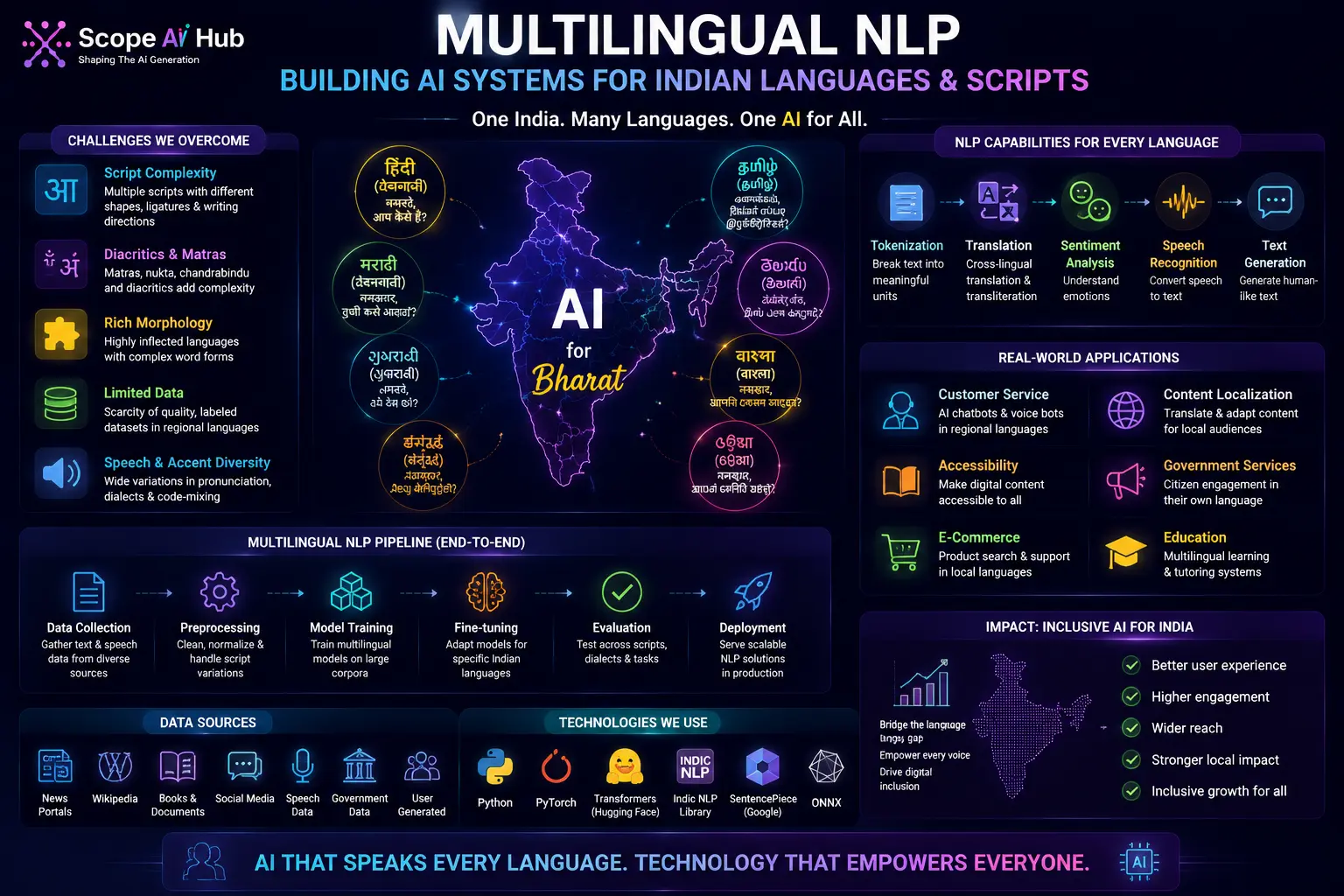
Indian-language and low-resource NLP. Building models that work well on Hindi, Tamil, Telugu, Bengali, and dozens of other Indian languages — many with limited digital text data available compared to English — requires specific technical skills: tokenization strategies for non-Latin scripts, transliteration handling, code-mixing (Hinglish and similar) processing, and evaluation methodologies for low-resource languages. This is a genuinely scarce skillset globally, not just in India, which makes it valuable.
Voice and speech AI. Because voice interfaces are central to reaching India's next hundred million internet users, speech-to-text, text-to-speech, and voice AI skills specific to Indian languages and accents are in real demand at companies working in this space.
Model efficiency and fine-tuning. Skills in fine-tuning, quantization, distillation, and efficient training of smaller models are directly relevant to the "frugal AI" approach these companies take, and are also broadly valuable skills as the whole industry (not just India) increasingly cares about deployment cost and efficiency, not just raw capability.
Data curation for underrepresented languages. Sourcing, cleaning, and annotating high-quality training data in Indian languages is unglamorous but essential work, and companies building sovereign models need people who understand both the technical pipeline and the linguistic nuance involved.
If you're weighing generative AI career paths generally, it's worth reading our broader overview of generative AI career paths in India alongside this piece — the sovereign LLM trend is one specific, high-growth lane within that larger landscape.
Is This a Competing Story to Global AI Adoption?
Not really — it's complementary. Most Indian enterprises will keep using a mix of global models (GPT, Gemini, Claude) for general-purpose tasks and Indian sovereign models for language-specific, voice-first, or data-sensitive use cases where local models perform better or compliance requirements make them preferable. If anything, this mirrors what's happening with AI adoption inside Indian businesses more broadly — see our piece on AI automation and business adoption in India for that wider picture. The practical implication for your career is that fluency in both — knowing how to work with global foundation models and understanding the Indian-language AI landscape — makes you more valuable than specializing in only one.
Frequently Asked Questions
Do I need to know Indian languages fluently to work in this field? Not necessarily fluently, but a working understanding of at least one Indian language beyond English is a real advantage for roles involving Indian-language NLP, since it helps with data quality assessment, evaluation, and catching model errors native English speakers might miss.
Is sovereign AI only relevant for government or defense applications? No. While data sovereignty and national security are part of the motivation, sovereign Indian LLMs are being built primarily for commercial and consumer applications — customer service, voice assistants, regional-language content, and enterprise tools — where Indian-language performance and cost efficiency matter more than raw benchmark scores.
How is this different from just fine-tuning GPT or Gemini on Indian data? Companies like Sarvam and Krutrim are training models largely from scratch or with substantial architectural and data pipeline control, not simply fine-tuning an existing global model through an API. This gives them more control over cost, deployment, data handling, and language-specific performance than API-based fine-tuning typically allows.
What's the realistic entry point into this field for someone starting out? Start with strong NLP fundamentals (tokenization, embeddings, transformer architecture), then specialize by working on projects involving Indian-language text or speech data — this combination of general NLP competence plus demonstrated Indian-language project work is what makes candidates stand out for roles at these companies.
Get Started
Scope AI Hub's generative AI and NLP-focused training programs in Chennai cover the foundations you need to work in this fast-growing space, from transformer fundamentals to practical fine-tuning projects. Explore our course catalog or reach out at /contact to discuss the right learning path for you.
Scope AI Hub
Verified PublisherAI Education & Research Team
Scope AI Hub is Chennai's leading AI training institute, delivering industry-driven, hands-on AI education since 2019. Our expert team covers Generative AI, Machine Learning, NLP, Data Science, and MLOps.
Ready to Start Your AI Journey?
Join thousands of students who transformed their careers with hands-on AI training at Scope AI Hub.