Object Detection vs Image Classification: What's the Difference?

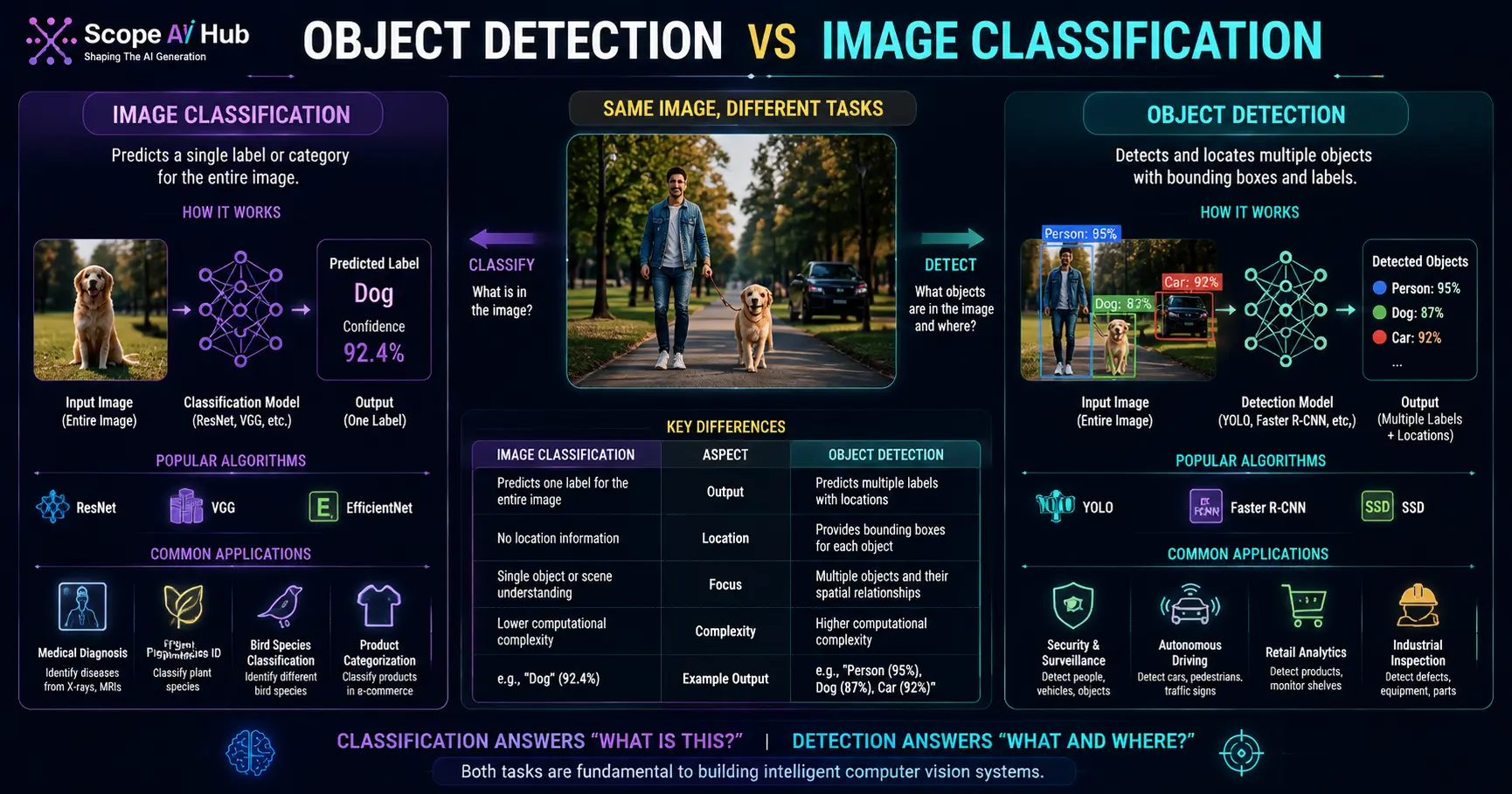
Computer vision tasks look similar on the surface — you feed images into a model and get predictions out. But "classify this image" and "detect objects in this image" are fundamentally different problems, and conflating them leads to picking the wrong tool, underestimating project complexity, or building something that does not actually solve the business problem.
This guide explains the distinction precisely, covers the main algorithms used for each, and gives you a framework for deciding which approach a given problem requires.
Image Classification: One Label Per Image
Image classification answers a single question: what is the primary subject of this image?
The output is a category label (or a ranked list of labels with confidence scores). The model sees the entire image and produces one prediction.
Example outputs:
- "This image is a dog" (confidence: 0.94)
- "This image is a chest X-ray showing pneumonia" (confidence: 0.87)
- "This product image shows a defective circuit board" (confidence: 0.91)
The model does not tell you where in the image the dog is, how many dogs there are, or whether there is also a cat in the corner. It provides a single global label.
When Classification Is the Right Choice
Classification is appropriate when:
- The business question is "what category does this image belong to?"
- One image corresponds to one thing (a product photo, a medical scan, a document type)
- You do not need location information
- You need to route or filter images into categories
Real applications:
- Quality control: Is this manufactured part acceptable or defective?
- Document routing: Is this scanned document an invoice, a purchase order, or a contract?
- Medical screening: Does this skin lesion image look benign or suspicious?
- Content moderation: Does this user-uploaded image contain inappropriate content?
How Classification Models Work
Modern image classifiers use Convolutional Neural Networks (CNNs). The network learns to extract increasingly abstract features from the image through successive convolutional layers, then uses a fully connected layer to map those features to class probabilities.
Standard architectures:
- ResNet (50, 101, 152 layers) — residual connections that allow very deep networks to train stably
- EfficientNet — scales depth, width, and resolution together for better accuracy/compute tradeoff
- Vision Transformer (ViT) — applies transformer self-attention to image patches instead of convolutions
In practice, you almost never train these from scratch. You use a pretrained model (trained on ImageNet's 1.2 million labeled images) and fine-tune it on your specific dataset — a process called transfer learning.
import torch
import torchvision.models as models
import torch.nn as nn

# Load pretrained ResNet50
model = models.resnet50(pretrained=True)

# Replace the final layer for your number of classes
num_classes = 3  # e.g., defective / acceptable / uncertain
model.fc = nn.Linear(model.fc.in_features, num_classes)

# Fine-tune: freeze early layers, train later layers
for name, param in model.named_parameters():
    if 'layer4' not in name and 'fc' not in name:
        param.requires_grad = False
Fine-tuning on a few thousand labeled images typically achieves production-quality accuracy for classification tasks.
Object Detection: Labels Plus Locations
Object detection answers a more complex question: what objects are present in this image, and where exactly are they?
The output is a list of detections, each containing:
- A bounding box (x, y coordinates of the box corners)
- A class label (what object this is)
- A confidence score (how certain the model is)
Example output for a single image:
[
  {"class": "car", "confidence": 0.95, "box": [120, 80, 340, 220]},
  {"class": "person", "confidence": 0.88, "box": [450, 60, 520, 280]},
  {"class": "traffic light", "confidence": 0.76, "box": [200, 10, 240, 70]}
]
The model can detect multiple objects of different classes simultaneously, and it tells you precisely where each one is in the image.
When Detection Is the Right Choice
Detection is required when:
- Multiple objects of interest can appear in a single image
- You need to know where objects are located (for counting, tracking, or triggering actions based on position)
- Objects need to be distinguished from background context
- You are building surveillance, autonomous systems, or real-time monitoring
Real applications:
- Retail shelf monitoring: Count product facings, detect out-of-stock gaps
- Traffic analysis: Count vehicles by type, detect violations
- Manufacturing inspection: Locate defects precisely on a product surface
- Medical imaging: Identify and locate tumors, fractures, or anomalies within a scan
- Agriculture: Detect diseased plants, count fruit on trees
How Detection Models Work
Detection is harder than classification because the model must simultaneously learn what and where. This requires architectures designed specifically for spatial prediction.
Two-stage detectors (R-CNN family):
- A region proposal network identifies candidate object locations
- A classifier examines each candidate region and refines the bounding box
Two-stage detectors are more accurate but slower — suitable for applications where latency is less critical.
One-stage detectors (YOLO family, SSD): The model directly predicts bounding boxes and class probabilities in a single forward pass. Faster but historically slightly less accurate. YOLO (You Only Look Once) is the dominant one-stage detector — YOLOv8 and YOLOv10 achieve near-two-stage accuracy at real-time speeds.
from ultralytics import YOLO

# Load a pretrained YOLOv8 model
model = YOLO('yolov8n.pt')  # 'n' = nano (fastest), also s, m, l, x

# Run inference on an image
results = model('factory_floor.jpg')

# Process detections
for result in results:
    boxes = result.boxes
    for box in boxes:
        cls = int(box.cls[0])
        conf = float(box.conf[0])
        xyxy = box.xyxy[0].tolist()  # [x1, y1, x2, y2]
        print(f"Class: {model.names[cls]}, Conf: {conf:.2f}, Box: {xyxy}")
Fine-tuning YOLO on custom data requires labeled images with bounding box annotations — significantly more labeling effort than classification labels.
Beyond Detection: Segmentation
If you need even more precision about object location — not just a box, but the exact pixel outline — that is segmentation.
Instance segmentation (e.g., Mask R-CNN, YOLOv8-seg) produces a pixel mask for each detected object. Useful when you need precise object boundaries for measurement, counting, or downstream processing.
Semantic segmentation labels every pixel in the image with a class, without distinguishing between individual instances of the same class. Used in autonomous driving (classify all road pixels, all sky pixels, etc.) and medical imaging (segment organ regions).
The Decision Framework
Question 1: Does location matter?
- No → Classification
- Yes → Detection or Segmentation
Question 2: How precise does the location need to be?
- Rough bounding box → Detection
- Exact pixel boundary → Segmentation
Question 3: Can multiple objects of interest appear in one image?
- One object per image → Classification may suffice (easier to label, faster to train)
- Multiple objects → Detection
Question 4: What are your latency requirements?
- Real-time (video, live monitoring) → One-stage detector (YOLO)
- Batch processing (overnight analysis) → Two-stage detector for higher accuracy
Labeling Cost Comparison
This is often the deciding practical factor:
- Classification: One label per image. A non-expert can label hundreds per hour. Labelbox, Roboflow, or even a simple spreadsheet works.
- Detection: One bounding box per object per image. Drawing boxes requires more time — expect 10-30 images per hour depending on density.
- Segmentation: Pixel-level outlines per object. Slow and expensive — typically requires specialized annotation tools and significant time per image.
For detection and segmentation, annotation platforms like Roboflow, CVAT, or Label Studio provide efficient box/polygon drawing tools.
Learning Path
Our Machine Learning and Deep Learning course covers CNN architectures and transfer learning for classification. The Computer Vision specialization goes further into detection with YOLO, segmentation, and building real-time vision pipelines — the skills needed for production computer vision work in manufacturing, retail, and healthcare applications.
Frequently Asked Questions
Q: Can I convert a classification model into a detection model? A: Not directly. Classification and detection architectures are different. A classification model can tell you what is in an image but not where. You would need to train a detection model, which requires bounding box annotations.
Q: Which is harder to build? A: Detection is significantly harder — more complex architecture, more labeling effort, more hyperparameters to tune, and more failure modes (missed detections, false positives, poor box localization). Start with classification if it solves your problem.
Q: What accuracy can I expect? A: For classification with transfer learning and 1,000-5,000 labeled images, 90%+ accuracy is achievable on clean datasets. For detection, mean average precision (mAP) of 0.7-0.85 is typical for well-trained models on reasonably complex scenes. Performance degrades significantly for small objects, occluded objects, and unusual lighting.
Q: Do I need a GPU? A: For inference (running a trained model), modern CPUs can run classification and small detection models at acceptable speeds for batch processing. For real-time detection (30fps video), a GPU is typically needed. For training, a GPU is essentially required — training on CPU is 10-100x slower.
Ready to Build Computer Vision Systems?
Our hands-on batches in Chennai cover the full pipeline from image preprocessing through model training and deployment.
📞 Call/WhatsApp: +91 70102 30379 📧 Email: info@scopeaihub.com 📍 Visit Us: 10, Tilak St, T. Nagar, Chennai – 600017 🌐 Website: www.scopeaihub.com
Scope AI Hub
Verified PublisherAI Education & Research Team
Scope AI Hub is Chennai's leading AI training institute, delivering industry-driven, hands-on AI education since 2019. Our expert team covers Generative AI, Machine Learning, NLP, Data Science, and MLOps.
Ready to Start Your AI Journey?
Join thousands of students who transformed their careers with hands-on AI training at Scope AI Hub.


